
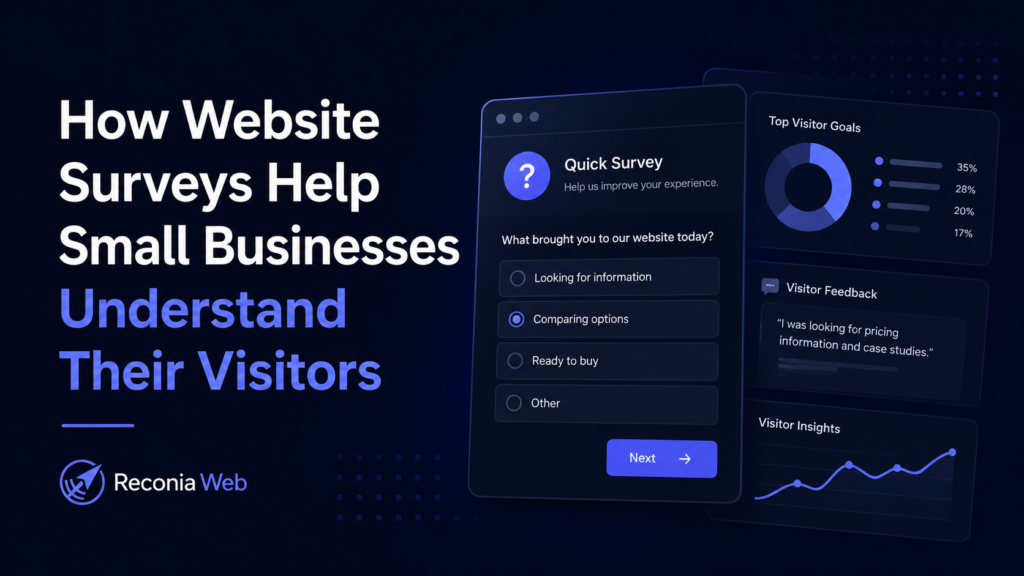
A business website should not be built only around what the company wants to say. It should also reflect what visitors need to know, what confuses them, and what prevents them from taking the next step.
This is where website surveys can be useful. A short survey placed on a website, shared after a service interaction, or sent to customers by link can reveal practical information that analytics tools alone may not explain. Analytics can show that visitors leave a page. A survey can help explain why.
For small businesses, surveys do not need to be complex. Even a few well-written questions can help improve website structure, service descriptions, customer experience, and future marketing decisions.
Why Feedback Matters for a Business Website
Many websites are created based on internal assumptions. A business owner may believe that visitors care most about price, while customers may actually want to understand experience, guarantees, service areas, or project timelines.
Without feedback, it is easy to redesign pages, rewrite content, or change service offers without knowing what real users think.
Website surveys help business owners ask direct questions such as:
What information was missing from the page?
Was the service description clear?
What made you hesitate before contacting us?
How did you find our website?
Which service are you most interested in?
What would make this offer easier to understand?
The answers can highlight small but important problems. Sometimes the issue is not the design itself, but unclear wording, hidden contact details, weak service explanations, or the absence of trust signals.
Surveys Help Improve Website Structure
A clear website structure is one of the most important parts of online presence. Visitors should quickly understand what the business does, where it works, and how to contact it.
Surveys can show whether that structure is actually working.
For example, if several visitors say they could not find pricing details, the website may need a clearer pricing section or a “request a quote” explanation. If users say they did not understand the difference between services, each service may need a separate page. If people are unsure whether the business works in their area, the location and service area information should be more visible.
This kind of feedback helps turn a website from a static brochure into a practical customer communication tool.
Surveys Can Support Better Website Copywriting
Good website copy should answer real customer questions. But many business websites use broad phrases like “high-quality solutions,” “professional service,” or “customer-focused approach.” These phrases sound familiar, but they often do not explain much.
Survey responses can provide the language customers actually use. If customers describe their problem in simple words, those words can become the basis for better headlines, service descriptions, FAQ sections, and landing pages.
For example, a web design studio may describe its service as “digital presence development,” while customers may simply ask, “Can you build a website I can update myself?” The second phrase is often more useful for website copy because it reflects a real concern.
When to Use a Survey on Your Website
A survey can be useful at different stages of a website project.
Before creating a website, it can help understand what potential customers care about most. During a redesign, it can reveal what is confusing or missing from the current site. After launch, it can help check whether the new structure works as expected.
Surveys are also useful after specific actions. For example, a business can send a short feedback form after a consultation, service request, purchase, appointment, or support conversation. The goal is not to collect as many answers as possible, but to ask the right questions at the right moment.
What Kind of Questions Should You Ask?
The best website survey questions are simple, specific, and easy to answer. A long survey can discourage users, especially if they are visiting from a mobile device.
For website feedback, a small business can start with questions like:
Did you find the information you were looking for?
What was the main reason for your visit today?
Was anything unclear on this page?
What nearly stopped you from contacting us?
Which service are you interested in?
How can we make this page more helpful?
For customer experience feedback, the questions may be slightly different:
How satisfied were you with the service?
Was communication clear?
What could we improve?
Would you recommend us to another person?
What was the most valuable part of the experience?
The survey should match the business goal. A feedback form for a restaurant, a home repair company, a consultant, and a web design studio should not look exactly the same.
The Tool that Really Helps
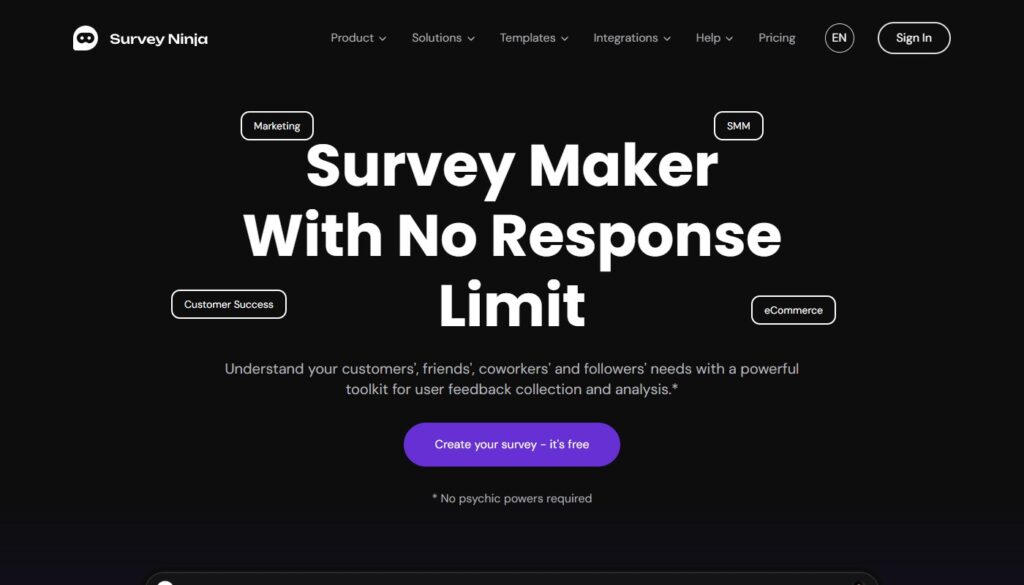
One practical way to create website surveys is to use a dedicated survey builder such as Survey Ninja. It is an online service for creating surveys, questionnaires, tests, market research forms, feedback forms, registration forms, and polls without technical skills.
For small businesses, this type of tool is useful because it keeps survey creation separate from the website development process. You can create a feedback form, share it as a link, embed it on a page, or use it after a customer interaction.
Survey Ninja includes features that are helpful for website feedback, including logic jumps, detailed summaries and analysis, multiple survey elements, adaptive design, export options, collaboration, and integrations such as Google Sheets and Slack.
This means a business can start with a simple survey and later make it more advanced. For example, if a respondent chooses “I could not find the information I needed,” the next question can ask what exactly was missing. If someone selects a specific service, the survey can show a follow-up question related to that service.
What to Do With Survey Results
Collecting answers is only the first step. The real value appears when the business uses the feedback to improve the website.
If several visitors say the homepage is unclear, the first screen may need a stronger headline. If users do not understand the difference between services, the services page may need better grouping. If people ask the same questions again and again, those questions should become part of an FAQ section.
Survey results can also help prioritize website updates. Instead of changing everything at once, a business can focus on the issues that appear most often.
This makes the redesign process more practical. Decisions become based on real user input, not just personal preferences.
Surveys and Website Redesign
Before redesigning a website, many businesses focus on visuals. They want a new color palette, new images, or a more modern layout. These changes can help, but they do not always solve the main problem.
A pre-redesign survey can reveal what visitors actually struggle with. Maybe the contact form is too long. Maybe the service descriptions are too general. Maybe users want examples of previous work. Maybe the mobile version is difficult to read.
With this feedback, the redesign becomes more focused. The goal is not only to make the site look different, but to make it easier to use.
Surveys Can Help Local Businesses Too
Local businesses often think surveys are only for large companies. In reality, small local companies can benefit from them even more because every customer interaction matters.
A local repair service can ask what made customers choose them. A beauty studio can ask which booking information was missing. A consultant can ask which page helped the client decide to schedule a call. A contractor can ask whether project examples were clear enough.
These answers can improve not only the website, but also service presentation, advertising messages, and customer communication.
Final Thoughts
A website becomes stronger when it is built around real user needs. Design, content, navigation, and contact forms all work better when the business understands what visitors expect and where they hesitate.
Website surveys give small businesses a simple way to collect that insight. They can support better structure, clearer copywriting, smarter redesign decisions, and stronger customer experience.
Tools like Survey Ninja make this process easier by allowing businesses to create and analyze surveys without technical complexity. The important part is not just launching a survey, but using the answers to make the website more helpful, more understandable, and more effective.