
When business owners think about creating a new website, they often start with design. They imagine colors, fonts, images, animations, and the general “look” of the site. Design is important, but it should not be the first decision. Before a website can look good, it needs to make sense.
For a small business, website structure is the foundation. It determines how visitors move through the site, how quickly they understand the offer, and how easy it is for them to take the next step. Without a clear structure, even a visually attractive website can feel confusing, unfinished, or unconvincing.
At Reconia Web, we believe that a website should be planned around clarity first. The design should support the message, not hide the lack of one.
What Website Structure Really Means
Website structure is not only the menu at the top of the page. It includes the order of sections, the logic of pages, the way services are grouped, the placement of contact buttons, and the path a visitor follows from the first screen to the final action.
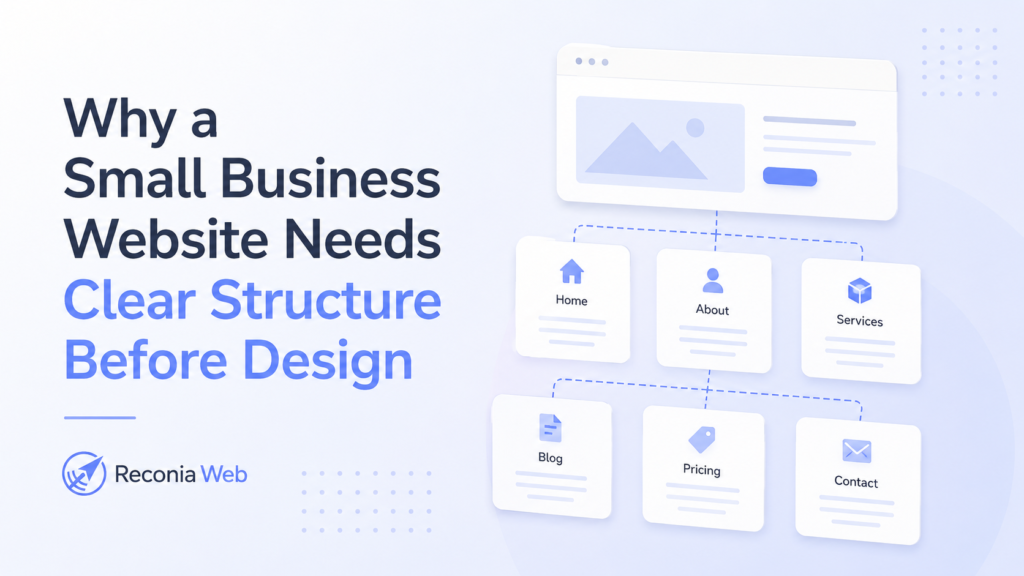
For example, a simple business website may include a homepage, services page, about page, contact page, and several individual service pages. But the real question is not how many pages the website has. The real question is whether each page has a clear role.
The homepage should explain the business quickly. The services page should show what the company offers. The about page should build trust. The contact page should make communication easy. If every page has a purpose, the website becomes easier to understand.
Why Structure Matters for First Impressions
Visitors usually decide very quickly whether a website feels trustworthy. They do not carefully read every word at first. They scan headlines, look at the layout, check the navigation, and try to understand whether they are in the right place.
If the first screen does not explain what the business does, the visitor may leave. If the menu is unclear, the visitor may not find the needed service. If the contact information is hidden, a potential inquiry may be lost.
A strong structure helps answer the most important questions immediately:
What does this company do?
Who is this service for?
Where does the business work?
Why should I trust it?
What should I do next?
When these answers are easy to find, the website starts working as a business tool.
Design Works Better When the Message Is Clear
Good design is not decoration. It is a way to organize information visually. The same colors, images, and typography can produce very different results depending on the structure behind them.
A homepage with random blocks will still feel weak even if it uses modern visuals. But a homepage with a strong order — introduction, services, proof, process, benefits, and contact — gives the designer a clear system to work with.
This is why Reconia Web usually starts with content logic before visual details. We need to understand what should be said, where it should appear, and what action each section should support. After that, design becomes more focused and effective.
Clear Structure Helps Customers Choose Faster
Small business websites often fail because they make visitors work too hard. A customer should not have to guess which service fits their situation or search through long paragraphs to find basic information.
If a company offers several services, each one should be presented clearly. If the business serves a specific local area, that should be visible. If the next step is to request a quote, schedule a call, or send a message, the website should make that obvious.
A structured website reduces hesitation. It helps people compare options, understand the offer, and decide whether to contact the business.
Structure Also Supports SEO
Search engines need structure too. Clear headings, logical pages, readable URLs, internal links, and focused service descriptions help search engines understand what the website is about.
For a local business, this can be especially important. A website should clearly show the company name, service type, location, contact information, and main areas of expertise. These details help both visitors and search engines connect the business with relevant searches.
SEO is not only about keywords. It is also about making the website understandable. A messy website with unclear page logic is harder to optimize, even if it contains the right phrases.
Common Structure Mistakes on Small Business Websites
One common mistake is trying to say everything on the homepage. The result is usually a long page with no clear focus. The homepage should introduce the business and guide visitors deeper, not replace every other page.
Another mistake is hiding important information. Phone numbers, service areas, working process, and contact forms should not be difficult to find. If the visitor is ready to reach out, the website should not create obstacles.
A third mistake is using generic sections that could fit any company. Phrases like “quality solutions” or “we help your business grow” do not explain much. A good website should be specific enough to feel real.
How Reconia Web Approaches Website Planning
At Reconia Web, we begin by understanding the business. We look at what the company offers, who the customers are, what questions visitors may have, and what action the website should encourage.
Then we plan the page structure. This includes the main menu, homepage sections, service blocks, calls to action, and contact points. Only after the structure is clear do we move deeper into design and production.
For some projects, this may lead to a compact website with a few focused pages. For others, it may require separate service pages, portfolio sections, landing pages, or a more detailed content system. The right structure depends on the business goal.
A Website Should Be Easy to Maintain
Structure matters not only before launch but also after it. A website with clear page logic is easier to update. Business owners can add new services, change text, replace images, or expand sections without breaking the whole site.
This is one reason why practical website platforms and builder-based solutions can work well for many small businesses. If the site is planned correctly, it can remain manageable after launch instead of becoming a technical burden.
Reconia Web helps clients choose solutions that match their real needs, not just current design trends.
Final Thoughts
A small business website does not need to be complicated to be effective. It needs to be clear, organized, and useful for real visitors.
Before choosing colors, animations, or visual effects, business owners should ask a more important question: will people understand what we do and how to contact us?
That is where strong website structure begins. And when the structure is right, design, content, SEO, and customer inquiries all have a stronger foundation to build on.